Imperialism by Hannah Arendt
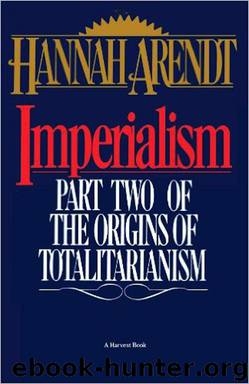
Author:Hannah Arendt
Language: eng
Format: epub
Publisher: Houghton Mifflin Harcourt
Published: 2016-02-16T16:00:00+00:00
III: Party and Movement
THE STRIKING and fateful difference between continental and overseas imperialism has been that their initial successes and failures were in exact opposition. While continental imperialism, even in its beginnings, succeeded in realizing the imperialist hostility against the nation-state by organizing large strata of people outside the party system, and always failed to get results in tangible expansion, overseas imperialism, in its mad and successful rushes to annex more and more far-flung territories, was never very successful when it attempted to change the home countries’ political structure. The nation-state system’s ruin, having been prepared by its own overseas imperialism, was eventually carried out by those movements which had originated outside its own realm. And when it came to pass that movements began successfully to compete with the nation-state’s party system, it was also seen that they could undermine only countries with a multiparty system, that mere imperialist tradition was not sufficient to give them mass appeal, and that Great Britain, the classic country of two-party rule, did not produce a movement of either Fascist or Communist orientation of any consequence outside her party system.
The slogan “above the parties,” the appeal to “men of all parties,” and the boast that they would “stand far removed from the strife of parties and represent only a national purpose” was equally characteristic of all imperialist groups,74 where it appeared as a natural consequence of their exclusive interest in foreign policy in which the nation was supposed to act as a whole in any event, independent of classes and parties.75 Since, moreover, in the Continental systems this representation of the nation as a whole had been the “monopoly” of the state,76 it could even seem that the imperialists put the state’s interests above everything else, or that the interest of the nation as a whole had found in them its long-sought popular support. Yet despite all such claims to true popularity the “parties above parties” remained small societies of intellectuals and well-to-do people who, like the Pan-German League, could hope to find a larger appeal only in times of national emergency.77
The decisive invention of the pan-movements, therefore, was not that they too claimed to be outside and above the party system, but that they called themselves “movements,” their very name alluding to the profound distrust for all parties that was already widespread in Europe at the turn of the century and finally became so decisive that in the days of the Weimar Republic, for instance, “each new group believed it could find no better legitimization and no better appeal to the masses than a clear insistence that it was not a ‘party’ but a ‘movement.’”78
It is true that the actual disintegration of the European party system was brought about, not by the pan- but by the totalitarian movements. The pan-movements, however, which found their place somewhere between the small and comparatively harmless imperialist societies and the totalitarian movements, were forerunners of the totalitarians, insofar as they had already discarded the element of snobbery
Download
This site does not store any files on its server. We only index and link to content provided by other sites. Please contact the content providers to delete copyright contents if any and email us, we'll remove relevant links or contents immediately.
| Elections & Political Process | Ideologies & Doctrines |
| International & World Politics | Political Science |
| Public Affairs & Policy | Specific Topics |
| United States |
The Secret History by Donna Tartt(19032)
The Social Justice Warrior Handbook by Lisa De Pasquale(12183)
Thirteen Reasons Why by Jay Asher(8884)
This Is How You Lose Her by Junot Diaz(6872)
Weapons of Math Destruction by Cathy O'Neil(6261)
Zero to One by Peter Thiel(5782)
Beartown by Fredrik Backman(5734)
The Myth of the Strong Leader by Archie Brown(5491)
The Fire Next Time by James Baldwin(5424)
How Democracies Die by Steven Levitsky & Daniel Ziblatt(5211)
Promise Me, Dad by Joe Biden(5141)
Stone's Rules by Roger Stone(5079)
A Higher Loyalty: Truth, Lies, and Leadership by James Comey(4946)
100 Deadly Skills by Clint Emerson(4911)
Rise and Kill First by Ronen Bergman(4776)
Secrecy World by Jake Bernstein(4738)
The David Icke Guide to the Global Conspiracy (and how to end it) by David Icke(4697)
The Farm by Tom Rob Smith(4500)
The Doomsday Machine by Daniel Ellsberg(4481)
